
That mole you’ve had for years and never paid attention to. That new spot that showed up on your shoulder after summer. Most of us completely ignore these details — until someone close to us goes through a serious scare, and suddenly everyone starts looking at their own skin differently. The good news is you don’t need to wait for that scare to take action.
The number that should be in every prevention campaign
Here’s the most important figure in this article, worth reading twice: when melanoma — the most dangerous form of skin cancer — is caught early, the five-year survival rate reaches 98%. When it’s discovered late, after it has already spread to other organs, that rate drops to around 24%. This contrast is documented in the protocol of a clinical study conducted by Oregon Health and Science University [1], which also estimates that 1 in 5 Americans will develop some form of skin cancer during their lifetime.
It’s not an exaggeration to say that, with this type of cancer, the time between noticing something odd and seeing a doctor can literally determine the outcome. And yet, a study published in the journal Frontiers in Medicine in 2024 shows that only 77.6% of melanomas are found while still localized [2] — meaning nearly 1 in 4 cases has already advanced beyond the point of highest cure probability by the time it’s identified. The same study reports an overall five-year survival rate of 93.5% for melanoma, rising to 99.6% specifically for cases caught early [2].
What actually causes skin cancer
The number one cause, by far, is exposure to ultraviolet (UV) radiation — whether from the sun or artificial tanning beds. But some factors significantly raise individual risk:
- Fair skin, light or red hair, light-colored eyes — less natural melanin means less protection against the sun.
- History of sunburns, especially during childhood and adolescence — the damage accumulates over a lifetime.
- Use of tanning beds, which emit concentrated UV and are recognized carcinogens.
- Many moles on the body or atypical moles, and family history of melanoma.
- Weakened immune system, whether from illness or immunosuppressive medications.
- Prior radiation therapy — a protocol study published on PMC shows that childhood cancer survivors treated with radiation have almost 40 times higher risk of non-melanoma skin cancer, and more than double the risk of melanoma, compared to the general population [3].
The signs your skin might be trying to tell you
Dermatologists use a simple, easy-to-remember rule — ABCDE — to identify suspicious moles:
- Asymmetry — one half of the mole doesn’t match the other
- Border that’s irregular, blurred, or notched
- Color that’s uneven — shades of brown, black, red, or even blue mixed together
- Diameter larger than 6mm (roughly the size of a pencil eraser)
- Evolving — any change in size, shape, color, or texture over time
If any mole matches two or more of these criteria, or if you notice a sore that won’t heal, that’s reason enough to book a dermatologist appointment — without waiting to “be sure” first. It’s no coincidence that the official U.S. prevention task force (USPSTF) formally reviewed the evidence on skin cancer screening in 2023, published in the renowned medical journal JAMA, to guide physicians on when to recommend this type of routine exam [4].
How to really protect yourself (beyond the obvious)
You already know you need sunscreen. But effective prevention goes a bit further than that:
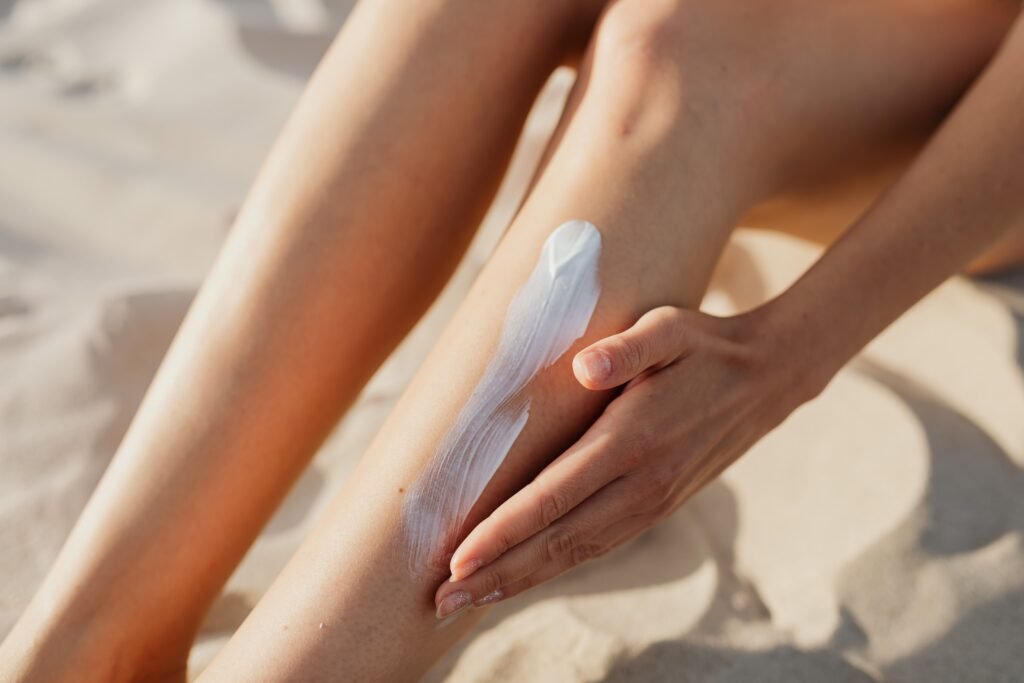
- Reapply sunscreen every 2 hours if you’re outdoors — applying it once in the morning doesn’t protect you all day.
- Avoid the sun between 10am and 4pm, when UV intensity peaks.
- Wear UV-protective clothing, a wide-brimmed hat, and sunglasses — physical protection matters just as much as sunscreen.
- Never use tanning beds — there’s no “safe dose” of that kind of exposure.
- Do a monthly self-exam, including areas you don’t normally check — scalp, soles of the feet, between the toes.
- See a dermatologist annually, especially if you have fair skin, many moles, or a family history.
Scientific references
- Clinical trial protocol on AI-assisted dermoscopy for early detection, Oregon Health and Science University (via ClinicalTrials.gov, NCT05321784).
- Multi-classification framework for skin cancer via dermoscopy images (2024). Frontiers in Medicine, 11.
- Advancing Survivors’ Knowledge (ASK) about skin cancer study — research protocol on childhood cancer survivors. PMC.
- US Preventive Services Task Force — Skin Cancer Screening: Updated Evidence Report and Systematic Review (2023). JAMA.
- Skin Cancer Screening: The Paradox of Melanoma and Improved All-Cause Mortality (2024). Cutis, 113(2), 94-96.