
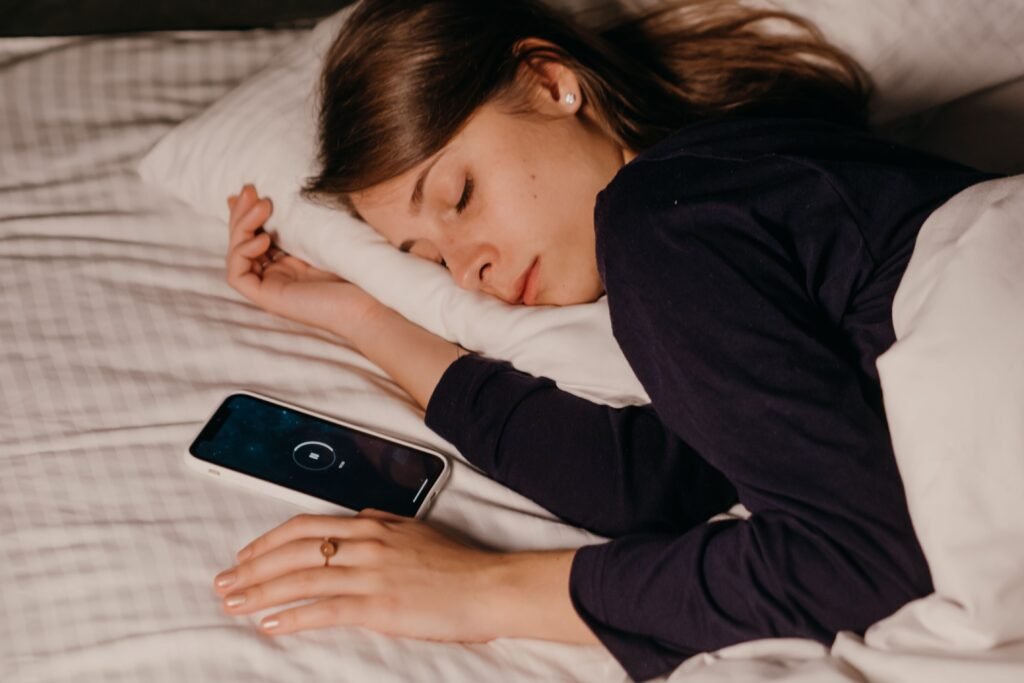
You wake up, still groggy, and the first thing you do is check your phone: “Sleep score: 68. Poor sleep.” And just like that, your day starts with the feeling that you already failed before even getting out of bed. Sound familiar?
Millions of people today outsource to a ring or a watch the answer to a question only your own body should really answer: “did I sleep well?” The problem is that these numbers don’t always tell the whole story — and understanding that can completely change how you relate to your sleep.
Why do we sleep so poorly, anyway?
Before we get into the tech, it’s worth understanding what’s sabotaging your sleep at the root. The most common causes are nothing mysterious:
- Screens until the last minute: blue light from your phone delays the release of melatonin, the hormone that tells your body it’s time to wind down.
- Caffeine too late in the day: even that 4pm coffee can still be active in your system hours later, without you noticing the connection.
- Irregular schedules: going to bed at 11pm one night and 2am the next confuses your biological clock more than consistently sleeping a bit less.
- Stress and a racing mind: anxiety and worry are, by far, the biggest thieves of deep sleep.
- Alcohol before bed: it helps you fall asleep, but fragments sleep in the second half of the night — which is why you wake up tired even after “sleeping.”
What science discovered about these devices
Here’s something few people know: researchers put the Oura Ring, Apple Watch, and Fitbit up against the real gold-standard sleep test — polysomnography, done in a lab with electrodes reading your brain activity. The results were revealing.
For the basic question “is this person asleep or awake?”, the devices do quite well — above 95% accuracy, according to a 2024 study published in the scientific journal Sensors in partnership with Brigham and Women’s Hospital, one of the leading hospitals in the United States [1]. So far, so good.
The problem shows up when the app tries to tell you which stage of sleep you were in. A 2024 study led by researcher Robbins and colleagues found something curious: the Apple Watch correctly detected 97% of sleep periods, but only recognized 52% of the moments the person was actually awake [2]. In other words: almost half of your “middle-of-the-night wake-ups” simply go unnoticed by the watch — and it still puts together a tidy score the next morning, as if it were completely certain of what happened.
An independent test published in the journal SLEEP Advances, from Oxford Academic, with six different devices — including Fitbit, Garmin, and WHOOP — confirmed the same pattern: some devices identified fewer than a third of the actual nighttime awakenings [3].
So how do I actually improve my sleep?
The good news is that sleep science, unlike wearable accuracy, is well established. None of these tips are revolutionary — but they’re the ones that actually work:
- Fix a wake-up time — including weekends. It’s more effective for regulating your body clock than fixing your bedtime.
- Cut screens 45-60 minutes before bed, or at least turn on night mode with amber light.
- Avoid caffeine after 2pm if you’re sensitive — caffeine’s half-life can exceed 5 hours.
- Keep the bedroom dark and cool — the drop in body temperature helps trigger deep sleep.
- Use your wearable as a trend gauge, not a daily verdict. Look at the weekly average, not a single night’s score.
And if, even after following all this, you keep waking up tired, snoring loudly, or feeling excessive daytime sleepiness, that’s no longer a “habit” issue — it’s time to see a sleep doctor. No smart ring replaces a clinical evaluation when sleep apnea or chronic insomnia are suspected.
Scientific references
- Sleep accuracy study comparing Oura Ring, Fitbit, and Apple Watch against polysomnography, in partnership with Brigham and Women’s Hospital (2024). Sensors, 24(20), 6532.
- Robbins et al. (2024). Comparative accuracy of sleep/wake sensitivity and specificity in Oura Ring Gen3, Fitbit Sense 2, and Apple Watch Series 8. Sensors, 24(20), 6532.
- Schyvens et al. (2025). Performance validation of six commercial wrist-worn wearable sleep-tracking devices. SLEEP Advances, Oxford Academic.