WellVibe · Health & Wellness
Senior Health · Strength & Mobility
Muscle Weakness After 60?
It’s Not Too Late to Reverse It
Understand what sarcopenia is, why it threatens your independence, and the simple steps to build strength at any age.
Close your eyes for a moment and picture an elderly person. What do you see? Probably someone hunched over, thin, walking slowly with a cane. Now ask yourself: does it have to be this way?
According to Dr. André Wambier, cardiologist and cardiovascular health specialist, the answer is no. That image of the frail elderly person is not a destiny — it is the consequence of something that can and should be prevented. And the name of that problem is sarcopenia.
What Is Sarcopenia — and Why You Need to Know This Word
Sarcopenia is the scientific name for the progressive loss of muscle mass and strength that comes with aging. It may sound like a complicated term, but what it describes is simple: your muscles gradually shrink over time — and if you do nothing about it, that loss accelerates sharply after age 50, potentially reaching 2% of muscle mass per year.
As Dr. André warns: “Sarcopenia is not just an aesthetic issue. It affects your health as a whole.” The numbers back him up: about 13% of people over 60 have sarcopenia. That figure climbs to nearly 50% in people over 80.
But here is the good news: contrary to what many people believe, it is possible to build muscle mass at any age. Your body never fully closes that door. What it needs is stimulation.
Losing Muscle Is Not Just About Looking Thin — It’s About Losing Independence
This is the point Dr. André makes sure to emphasize with every patient he sees: “One of the greatest fears people share with me is becoming dependent on their children, grandchildren, or a caregiver for the most basic things in life.”
When muscles weaken, everyday tasks become obstacles: carrying grocery bags, climbing stairs, getting up from a chair without help, lifting luggage into an overhead compartment. These are things we do without thinking — until the day we can no longer do them.
And the consequences go well beyond the physical. According to Dr. André, the loss of autonomy lowers self-esteem, increases the risk of depression and anxiety, and often leads to social withdrawal — which makes everything worse.
On the physical health side, those with less muscle are more likely to experience:
- Falls and fractures
- A slower metabolism
- Higher risk of diabetes, hypertension, and obesity
- Reduced lung capacity
- Circulatory and heart problems
- A weaker immune system
- And even a higher risk of dementia
On the topic of dementia, Dr. André shares a fact that surprises many people: “One of the major reasons women develop dementia at twice the rate of men is that they tend to have less muscle mass.” The good news, he stresses, is that this is a modifiable risk factor — meaning you can change the outcome.
What Science Says
Dr. André is not alone in sounding this alarm. The scientific community is increasingly clear on this. A systematic review published in 2025 in the Journal of Cachexia, Sarcopenia and Muscle confirmed that resistance training — such as weight lifting and resistance band exercises — is the first-line treatment for improving sarcopenia in older adults.
Another recent study published in Frontiers in Physiology (2025) analyzed dozens of controlled trials and confirmed that resistance exercise significantly improves muscle strength, walking speed, and the ability to perform daily tasks in older adults with sarcopenia.
And the American study Dr. André himself cites is equally striking: tracking more than 150,000 people between the ages of 60 and 70 over nine years, researchers found that those who exercised regularly had a 47% lower risk of dying from any cause compared to those who were inactive.
“You can start exercising at any age. Age is not an obstacle.”
— Dr. André Wambier, cardiologist
How to Know If You Are Losing Muscle
Dr. André describes the warning signs clearly. You may be dealing with sarcopenia if:
- You feel you have lost the energy and vitality you once had
- You walk more slowly than you used to
- You struggle to climb stairs or get up from a chair
- Your arms and legs look and feel thinner
- Your balance feels unsteady and you fear falling
- You tire easily during simple activities
If you recognized yourself in one or more of those points, don’t panic. As Dr. André puts it with a reassuring smile: “Don’t worry — there is still time!” The important thing is to start acting now.
🦩 The Flamingo Test — Try It Right Now
Dr. André presents a simple test that can reveal a lot about your muscular health. All you need is a watch and a safe spot nearby:
- Stand barefoot with your feet together
- Lift one knee to 90 degrees (like a flamingo)
- Try to hold that position for 10 seconds
- Repeat with the other leg
A 2022 study published in the British Journal of Sports Medicine asked people between 51 and 75 years old to do exactly this test. The result: 20% failed — and after seven years of follow-up, those who failed had an 84% higher risk of dying than those who passed. Balance tells us much more than we might think.
What To Do: Dr. André’s Practical Guide
The good news is that the solution exists and is straightforward (not easy, but straightforward). Dr. André summarizes it in four pillars: exercise, nutrition, rest, and, if needed, supplementation.
1. Move Your Body — The Right Way
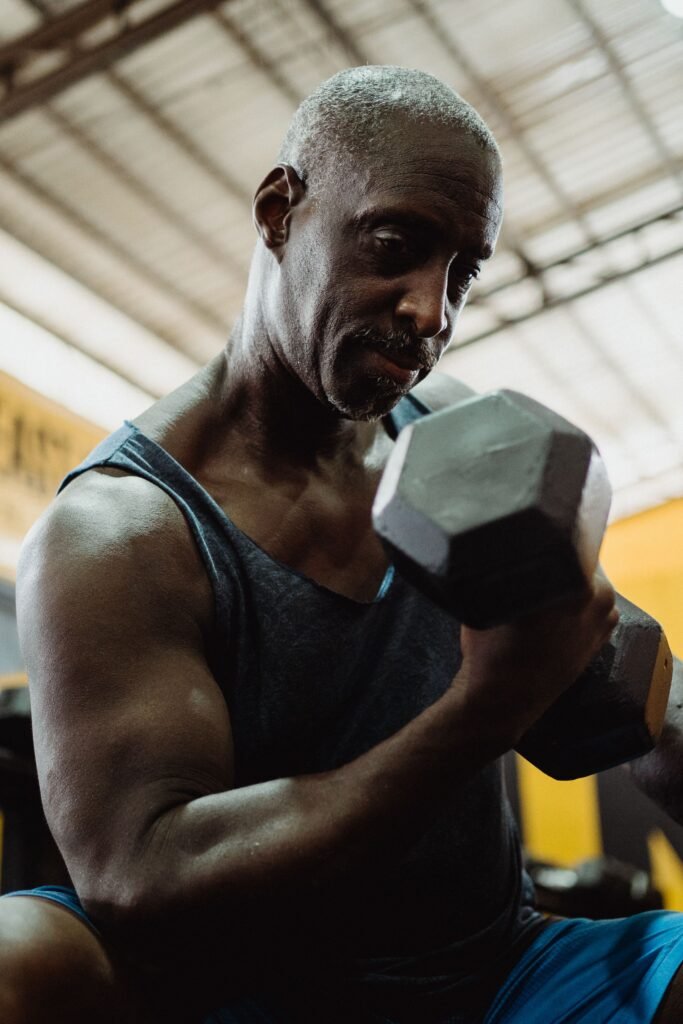
Without stimulation, muscle atrophies. That is the basic rule. And the most powerful stimulus for your muscles is resistance exercise — lifting weights, using resistance bands, doing squats, pushing and pulling against effort.
When you challenge a muscle, tiny damage occurs in the muscle fibers. The body then works to repair that damage — and it is during that repair process that the muscle grows and gets stronger. Dr. André explains it with a memorable analogy: “You know that marbled beef, full of fat, considered premium quality? It ends up that way because the animal was kept still and confined. The fat infiltrated between the muscle fibers. Delicious to eat — but terrible if it happens inside your own muscles.”
No gym required. Dumbbells at home, resistance bands, bodyweight exercises (squats, push-ups) — it all works. What you cannot do is stay still.
And remember: it is not only about lifting weights. The ideal combination includes three types of exercise:
- Aerobic (walking, swimming, cycling) — for your heart and lungs
- Resistance (weights, bands) — for your muscles
- Flexibility (stretching, yoga, pilates) — for your joints and posture
Dr. André’s minimum recommendation: at least 150 minutes of moderate activity per week — roughly 30 minutes a day, five days a week. For stretching, 15 to 30 seconds per muscle group already makes a real difference.
2. Eat to Build — The Fuel Your Muscles Need
As Dr. André explains, food is the fuel for your muscles. Without the right nutrients, not even the best workout in the world will work. And the most important nutrient of all is protein.
Protein is the building block of muscle. For people over 50, Dr. André recommends consuming at least 1.2 grams of protein per kilogram of body weight per day — and up to 1.6 or even 2.2 grams depending on activity level. In practical terms: a person weighing 154 lbs (70 kg) should aim for at least 84g of protein a day.
Good protein sources:
- Eggs (excellent and affordable)
- Natural yogurt and milk
- Meat and fish (sardines, tuna, salmon)
- Beans and rice (a classic combination)
- Plant-based options: lentils, chickpeas, quinoa, and tofu
Dr. André highlights something special about plant proteins: they supply the amino acids muscles need without putting as much strain on the kidneys — important because our kidneys become more sensitive as we age.
Beyond protein, don’t forget:
- Good carbohydrates (banana, apple, sweet potato, beets) — to fuel your workouts
- Healthy fats (olive oil, avocado, nuts) — for hormone production and vitamin absorption
- Fiber and fermented foods (yogurt, kefir) — for gut health, which directly influences muscle health
3. Sleep Well — Because Muscle Grows While You Rest
This is a point many people overlook. According to Dr. André, “it is during sleep that muscle fibers are repaired and the muscle grows.” Training hard and eating well without sleeping properly is like watering a plant and then leaving it in the dark.
The recommendation: 7 to 9 hours of sleep per night. And avoid smoking and alcohol, both of which directly harm muscle health and recovery.
4. Supplements — A Boost, Not a Crutch
Dr. André is direct on this: “Supplements are an extra, not the foundation.” If you are already eating well, training, and sleeping enough, you may not need them at all. But if you want an additional push, two have solid scientific backing:
- Whey Protein: helps reach your daily protein goals. Vegan options are available too.
- Creatine: improves strength, muscle mass, and performance in high-intensity exercise — with strong scientific evidence in older adults.
Other supplements (BCAAs, glutamine, beta-alanine) may help, but the evidence for them is less solid. Dr. André recommends focusing on the two above.
How Long Until You See Results?
This is one of the questions Dr. André hears most often. The honest answer: it depends on genetics, training intensity, and diet. But he assures that significant changes in strength and muscle volume are noticeable within 8 to 12 weeks of consistent effort.
The secret is not speed — it is consistency. Muscle doesn’t grow overnight, but with patience and routine, the results come. And every week of effort is already taking care of your health from the inside, even before you see it in the mirror.
Aging Well Is Possible — And There Are Real Examples
Dr. André often shares stories from his own patients to show that aging well is not a privilege reserved for a lucky few. One of them went on a hot air balloon ride at 87. Another passed away just weeks before turning 100 — never once hospitalized, still strong and active. The difference between them and the frail elderly person we tend to picture? It wasn’t luck — it was choice.
The Choice Is in Your Hands
Sarcopenia is not a destiny. It is a process that can be slowed, stopped, and in many cases reversed — regardless of your age. You can take your first step today: stand up from your chair a few extra times, add an egg to your breakfast, go to bed a little earlier.
As Dr. André says: “The important thing is to always try to improve. Progress — never atrophy.”
And if you’re curious about the flamingo test — go ahead and try it. Stand on one foot for 10 seconds. Your body will tell you a lot about where you need attention. And from there, you already know what to do.
About the specialist
The information in this article is based on the content of Dr. André Wambier, cardiologist and creator of the Cardio DF YouTube channel, dedicated to translating medical science into accessible language for the general public.
📷 Follow Dr. André on Instagram → @drandrewambieroficialReferences & Sources
[1] Dr. André Wambier — Cardio DF
“Your muscle weakness has a solution! How to gain muscle after 60” — original video on YouTube, Cardio DF channel.
[2] Metabolism Journal (2023)
Yuan S., Larsson S.C. — Epidemiology of sarcopenia: Prevalence, risk factors, and consequences.
metabolismjournal.com → read article
[3] Nature Reviews Endocrinology (2020)
Després J.P. et al. — Waist circumference as a vital sign in clinical practice — on visceral fat, metabolic health, and aging.
nature.com → read article
[4] BBC News Brasil
Report on healthy aging and muscle strength in older adults.
bbc.com/portuguese → read article
[5] BBC News Brasil
Report on the balance test and mortality risk in older adults.
bbc.com/portuguese → read article
This article is for informational and educational purposes only. It does not replace the evaluation of a qualified healthcare professional. Before starting any exercise program or dietary change, please consult your doctor.